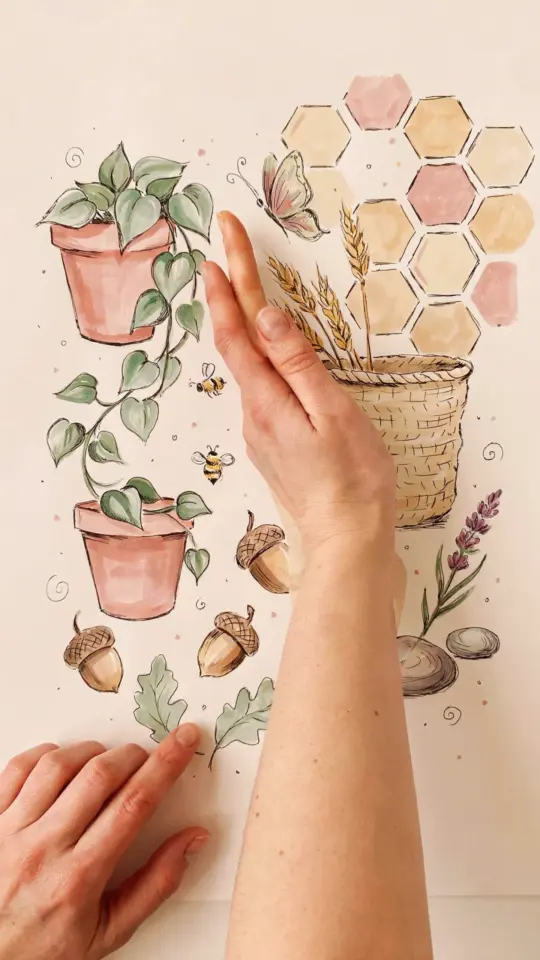
If you have ever sat down with a blank sketchbook, pen in hand, and felt your mind go blank, you are not alone. Doodle art ideas for beginners can feel overwhelming because we often think doodling needs to look polished from the start. The truth is, most beginners make the same few mistakes that kill the fun before it even begins. I have made every single one of them, and I want to help you skip the frustration. Instead of chasing perfection, let us look at the common pitfalls and how to sidestep them so your sketchbook practice actually becomes a relaxing creative habit.
Overthinking and Perfectionism – How to Start Doodling Without Fear
The biggest mistake I see in doodleart for beginners is treating every mark like it has to be gallery-ready. You pick up a pen, hesitate for ten seconds, and then draw a tiny line. Then you erase it (if you are using pencil) or scratch it out. That hesitation kills the flow.
Here is the fix: give yourself permission to draw ugly doodles. Seriously. The whole point of doodleideas is to let your hand wander without a critic in your head. Pick a corner of a page and make random loops, zigzags, or dots. Do not try to make a composition. Just move the pen. Within two minutes your hand will loosen up, and those ugly marks will turn into something that feels like you.
I keep a “junk page” in every sketchbook where I scribble nothing but bad, messy, pointless doodles. That page is my warm-up. It reminds me that being a beginner means you are learning, not performing. And that is exactly where beginnerdrawing confidence comes from.
Picking the Wrong Tools – Simple Doodle Supplies That Actually Work
Another mistake is assuming you need fancy markers or a specific pen weight to create easydoodles. I fell into that trap. I bought a set of expensive fineliners and then felt too scared to use them because I did not want to “waste” them on something imperfect.
Here is what I actually recommend for beginners:
- A cheap ballpoint pen – it glides smoothly, dries fast, and has zero pressure to be perfect.
- A regular office pencil (HB or 2B) – you can sketch lightly and then go over lines when you are happy.
- A small sketchbook that fits in your bag – not a fancy hardcover, just a cheap spiral notebook.
That is it. No special paper, no expensive brush pens. Once you are comfortable making lines without fear, then you can experiment with tools. But for starting out, simple supplies remove the mental barrier. I personally use a Bic ballpoint for almost all my doodleart now because the slight scratchiness gives my lines character.
Filling Every Blank Space – The Power of Negative Space in Doodle Art
When I first started, I thought a “finished” doodle had to cover the entire page. So I would cram shapes into every corner until the page felt cluttered and chaotic. That is a fast track to frustration because you never get a sense of completion.
Negative space is your friend. Leave areas blank. Let your eye rest between patterns. For instance, if you draw a simple petal shape, leave a finger-width gap before adding the next one. Those empty spaces make the
#doodleart #doodleideas #easydoodles #sketchbookinspiration #beginnerdrawing
Leave a Comment