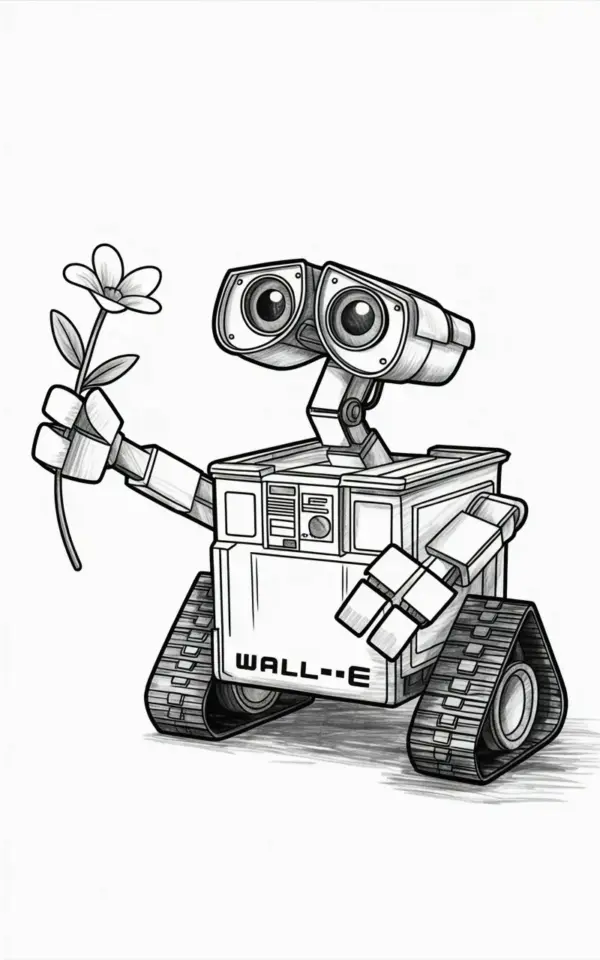
Every time I sat down for pencil sketching Wall-E, I ended up with a robot that looked more like a battered trash bin than a beloved character. The mistake was almost automatic: I kept shading the metal panels, adding rivet after rivet, until the texture swallowed every hint of personality. Then I started leaving lines unfinished and suddenly my sketchbook version of Wall-E began to feel alive, curious, even sweet. That tiny shift, from perfect rendering to loose expression, is the real inspiration behind a memorable robot drawing.
Why Overworking Metal Panels Kills the Expression
The square metal body with visible panels and rivets is tempting to refine, but every extra stroke moves you further from the character. Disney’s Wall-E is not a machine study, he is a lonely soul with a hobby. In pencil form, those panels should exist as suggestions, not as a checklist of bolts and seams.
When you treat each rivet as a separate task, the head starts to feel heavy and the eyes lose their softness. Instead, sketch only a few structural marks and let the viewer’s brain fill in the rest. Your paper will feel lighter, and Wall-E will look like he is about to move, not like a static model on a shelf.
The goal is to capture a personality that overflows from a rusty chassis. Hatching a single line across the chest plate, then walking away, is often more powerful than blending every shadow to a smooth gray.
Affordable Sketching Supplies That Do the Job
You do not need a premium art kit to make a convincing Wall-E pencil sketch. A standard HB pencil from the drugstore, a cheap eraser, and a sheet of copy paper are enough to practice the loose style. Honestly, the simplest setups often produce the freshest drawings because there is no pressure to use fancy tools correctly.
If you have a small budget and want one upgrade, pick a mechanical pencil with 0.7 mm lead. It keeps a consistent line width without sharpening breaks. A kneaded eraser is also handy for lifting graphite in the eye area, but a regular vinyl eraser works fine for erasing whole lines.
For a complete starter pack on a budget, look for these:
- Two graphite pencils: one HB for light lines and one 2B for the darkest eye or flower accents.
- A vinyl eraser or a kneaded eraser, whichever costs less at your local store.
- Printer paper or a basic spiral sketchbook, no need for heavy cotton paper.
- A ruler only if you want to draw the wheel base evenly, but freehand is often better.
That whole kit should cost less than a ten-dollar bill. The real investment is your willingness to leave mistakes visible.
Drawing Wall-E’s Eyes Without Perfect Symmetry
The large circular eyes are the emotional center of this robot, so they deserve a careful hand but not a rigid one. In the reference photo, his eyes have that classic binocular shape, huge and dark, framed by a lighter outer ring. If you draw both circles perfectly identical, they can look vacant, like camera lenses instead of eyes.
Give one eye a slightly higher highlight or a softer edge. Let the tiny reflections break the circle, because those small bumps of white paper create a glassy, curious stare. The single flower stem with a simple petal sits near his hand, and that flower needs the same treatment, gentle curves rather than exact botanical detail.
Keep the gaze slightly tilted upward, as if he is looking at the flower or at the viewer with wonder. Even a slight shift in the eyebrow plates changes the whole mood, so test two or three options before committing to a dark line.
How to Sketch the Flower So It Feels Delicate
The bloom is nothing more than a thin stem, one small leaf, and a single petal, but it carries the entire story of the drawing. In your pencil sketch, use very subtle curved lines for the stem instead of a stiff straight line. A tiny bend near the top makes it feel organic, like it could sway in a breeze.
Do not outline the petal with heavy pressure. Light strokes let the white paper glow around the graphite, which gives the flower a fragile quality. The same rule applies to the leaf, keep it simple and slightly curved, and resist the urge to add veins or shading.
Wall-E is holding this flower, but his hand is a mechanical claw made of flat shapes. Draw the claw with even, relaxed spacing, leaving tiny gaps between the fingers. That contrast between the angular metal and the curved plant is what makes the flower feel special.
Keep the Body Loose and the Wheels Grounded
The top rectangle of Wall-E’s body sits at a slight angle in the photo, showing one side and part of the front profile. This is your chance to make the sketch look candid rather than posed. Angle the torso a few degrees off vertical and let the shoulder line dip naturally.
At the bottom, rounded wheels visible from the side anchor the whole figure. Draw the wheels as simple circles or half-circles with a little line to show the rubber separating from the metal hub. Do not shade every tread; just suggest the ridges and move on.
If the body panels are too symmetrical, your Wall-E will feel stiff. Make one side of the chest slightly taller or tilt the whole body toward the flower. That irregularity imitates a character who has been moving around for centuries, collecting treasures and curious scrap.
Use the flat side of your pencil to mark a few rough gray tones on the darkest parts, like the eye sockets or the lower wheel area. Then leave the rest of the paper bare to catch the light. This budget-friendly technique creates depth without needing expensive blending tools.
A Practical 10-Minute Wall-E Warm-Up Exercise
Before you commit to a final drawing, warm up with a timed session that removes all expectation of perfection. Set a timer for ten minutes and sketch the robot from the image using only four basic steps: frame the head, place the eyes, drop the body lines, and suggest the wheels. If a line misses, leave it and draw another.
Try this routine to build muscle memory for the loose style:
- First minute: sketch two circles for eyes, far apart and large.
- Second minute: add the eyebrow plates and the dark eye fill.
- Next three minutes: shape the metal body with quick, straight lines.
- Then two minutes: draw the arm holding the flower, keeping the stem thin.
- Final two minutes: add wheels, a few rivets, and stop.
After that warm-up, start a fresh page and take a more deliberate approach. You will notice that your hand remembers the important landmarks, so you can spend more time on the eyes and the curve of the flower stem. This works as a sketchbook idea for any robot character, not just Wall-E.
Turn Sketchbook Mistakes Into Style
Every sketchbook page is full of ghost lines that you did not erase, and that is exactly what makes a loose illustration feel human. Instead of rubbing away every stray mark, let a few remain near the edges of the body or the wheels. Those visible search lines show the viewer how your eye moved, and they add energy to the final image.
When you sense that the metal panels are getting too heavy, stop and squint at your drawing. Squinting softens the details and helps you see the overall silhouette. If the shape reads as Wall-E even with rough edges, you are done.
Over time, you will learn the difference between finishing a sketch and smothering it. The flower, the curious eyes, and the simple body angle tell the story, so the panels and rivets are just background noise. Keep reminding yourself that less detail often equals more emotion.
Conclusion
The next time you reach for your pencil, try the light touch and see what changes in your Wall-E sketch. Let the double circles of his eyes stay imperfect, let the stem curve a little too much, and let your eraser rest most of the time. Your sketchbook will start to feel like a collection of tiny living moments instead of rusted machine parts.
Grab that budget pencil and a piece of scratch paper tonight. Sketch a single flower, a robot face, and a soft curious gaze, then leave the rest unfinished and call it a success. The character will thank you for it.
Leave a Comment