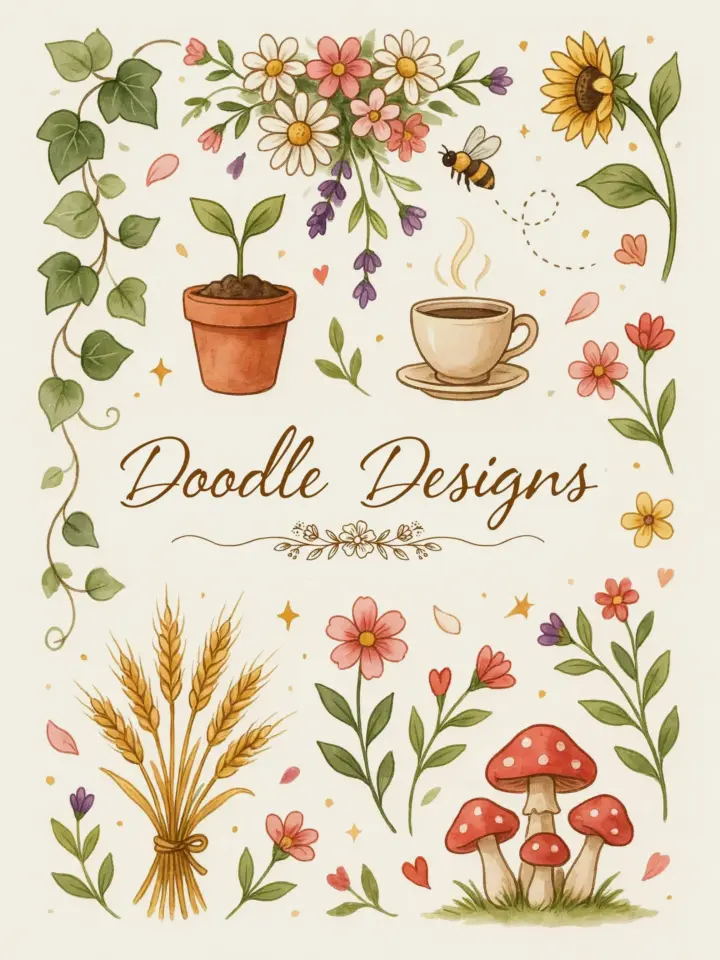
If you are looking for doodle designs for sketchbook that feel natural, approachable, and genuinely relaxing, you have landed in the right place. I have spent many quiet afternoons filling pages with simple lines and repeating shapes, and I have found that the best art for unwinding does not require skill, just a willingness to let your pen move. Whether you are new to doodleart or searching for fresh sketchbookideas, the following roundup of themed sections will give you practical starting points. Each theme is a little world of its own, designed to make relaxingdrawing feel effortless and fun.
Why Doodle Art Belongs in Your Sketchbook for Relaxation
Doodling is one of the most forgiving forms of drawing. You do not need perfect proportions or a steady hand, just a pen and a willingness to experiment. When I open my sketchbook with no plan, I often start with a single loop or dot and let my hand wander. That process quiets my mind in a way that planned drawings never do. It is also a fantastic way to warm up before tackling bigger projects. Keeping a dedicated doodle section in your sketchbook makes relaxation a daily habit, not an occasional event.
Whimsical Shapes: A Gentle Starting Point for Doodling
The easiest way to begin a relaxing doodle session is with whimsical shapes. Think of lopsided circles, wavy lines, and soft curves that look like they belong in a dream. I love drawing fluffy clouds, rounded leaves, and tiny crescent moons. These forms are forgiving, you can repeat them without worrying about symmetry. For a calming effect, try drawing a cluster of overlapping circles and then adding small dashes inside each one. This simple practice builds confidence and helps you lose track of time.
Pattern Play: Repeating Motifs for Calm Focus
Repeating patterns have a meditative quality that makes them perfect for relaxing drawing. When you fall into a rhythm, your breathing slows and your focus narrows. One of my favorite pattern exercises is creating a row of zigzags, then filling each triangle with parallel lines. Another is making a grid of small squares and decorating each one with a different dot arrangement. Here are a few pattern ideas you can try right now:
- Spiral clusters that expand outward like snail shells.
- Alternating waves and straight lines to create a gentle contrast.
- Small triangles arranged in a honeycomb formation.
- Checkerboard squares filled with tiny circles or crosses.
- Repeating arcs that form a scalloped border.
Start with one pattern per page. The repetition itself becomes a form of mindfulness, and your sketchbook will slowly fill with texture and movement.
Nature Inspired Doodle Elements for Grounding
Nature provides an endless library of shapes that feel both familiar and soothing. I often draw simple leaves, ferns, and vines because they flow naturally from my hand. You can try a single thin stem with small leaves alternating left and right, or a cluster of pine needles radiating from a center point. Another grounding idea is to sketch a row of mountains or hills, then add tiny trees near the base. These elements connect you to the outdoors even when you are sitting at a desk. They also work beautifully as corner accents in bullet journal spreads.
Abstract Line Work for Mindful Moments
Abstract doodling is about letting go of representation entirely. You draw lines, curves, and dashes without trying to make them look like anything specific. I enjoy starting with a single wavy line across the page and then adding parallel lines that slowly diverge. Another technique is to draw a random scribble and then outline the spaces between the scribbles to create unexpected shapes. The process feels like a conversation between your hand and your brain. There are no mistakes, only new directions. This type of doodling is especially good for quieting an overactive mind before bed.
Using Doodles in Bullet Journal Borders and Layouts
Once you have a collection of simple doodles, you can turn them into custom borders for your bullet journal or planner. A row of tiny stars or dots alternating with dashes makes a clean, minimal frame. For a more playful look, try a border of overlapping loops that resemble chain links. I also like to frame weekly spreads with a thin vine that has small leaves at regular intervals. The key is to keep the doodles small so they do not overwhelm the written content. Practice your border elements on scrap paper first, then draw them directly into your journal with a fine liner pen. The result feels personal and polished without requiring hours of work.
Tips for Building Your Own Doodle Vocabulary
Over time you will develop a personal set of favorite marks and motifs. That is your doodle vocabulary, and it grows naturally the more you draw. Keep a running list in
#doodle #art #doodleart #sketchbookideas #relaxingdrawing
Leave a Comment