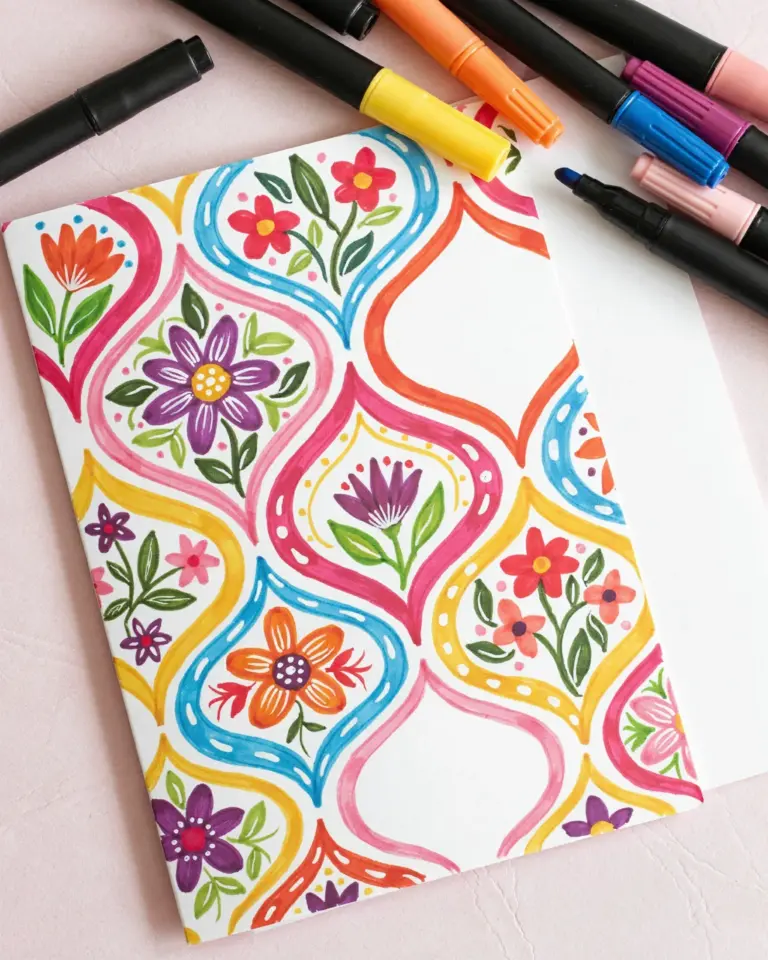
Okay, so you’re sitting there with a fresh page and a pen that feels full of potential. The first few marks feel good, confident. Then, without really thinking, you’re in the corner of the page drawing a tiny, perfect flower petal.
And then another petal.
And then you’re stuck, because that little flower is now the most detailed thing on the page, and the rest of the composition is a blank void staring back at you. This is the doodle drawing mistake that trips up more people than perfectionism or lack of ideas, starting with details instead of the big shapes.
It’s the reason your doodle art looks stiff, or why you feel like you’ve already messed up before you’ve even begun.
When you zoom in on the small stuff first, you lose the overall flow of the drawing. You also lose the relaxed, wandering energy that makes doodling such a great creative outlet in the first place. The fix isn’t more talent, it’s literally just changing the order of how you work. You need a map before you take a road trip, even if that map is just a few loose circles and lines.
Why we always want to start with the tiny details
Honestly, I think it’s because the details are the fun part. Ink a little mandala dot or a row of perfect hatching and you feel like you’re making “art.” But you’re actually just decorating a spot, hoping the rest of the drawing will magically catch up.
We also start with details because they’re safe. Investing in a single, small, achievable shape feels better than facing a big blank page that demands structure.
But here’s the problem: that tiny flower or that little geometric pattern becomes an anchor. It locks you into a corner of the page, and once it’s rendered so precisely, you feel like you have to match that level of intensity everywhere else. That’s exhausting. No wonder you abandon the page halfway through.
Before you draw, map the space
Take ten seconds, that’s it, and look at your page as a whole. Where is the main cluster of your drawing going to live? Is it in the center, or sweeping from the bottom left corner like a wave?
Use a light pencil, or even just barely-there pen pressure, and mark out where those main shapes will sit. A circle for the main form, a few sweeping lines for how the doodle patterns will flow.
This isn’t about making a perfect pencil sketch. You’re just building a skeleton, or a “blocking” stage like animators use. If the skeleton is balanced on the page, everything you grow from it will automatically feel more grounded. You’re setting up the composition so you don’t have to think about it later; you get to just play inside the zones you’ve created.
Big shapes make doodling feel easy
When you map the bigger picture first, the pen magically starts to move faster. You’re no longer worried about where to go next, because your hand already knows the boundaries of the shape, it just fills them in.
Let’s say you want to draw a fantasy-style doodle. Instead of drawing the tiny eyes and nose on a dragon face (classic mistake, you end up with a huge head and no body), you would:
– Sketch the giant curve of the back and tail as one continuous swoop.
– Add a big oval for the torso muscle and a smaller circle for the head placement.
– Then lightly mark where the wings start and end.
– Only after all that, you start laying in the scales, horns, and little details.
The result is a dragon that has actual presence, not just an overly detailed face floating in space. Your doodle art will look more dynamic, and nobody will notice that you skipped all those tiny patterns to begin with.
This is not about sketching before you draw
Look, I’m not telling you that you need to do a tight pencil outline and then color inside the lines. That’s a different process. For pure doodling, we want to stay loose.
What I’m suggesting is a re-order of your pen strokes. First stroke, big shape. Second stroke, big divider line. Third stroke, maybe a few sectioned-off areas to fill with your favorite doodlepatterns.
You’re still using a pen; you’re still making irreversible marks. That’s the fun of it. You’re just moving your focus from the micro to the macro. It also helps with the anxiety of getting stuck; if a big shape goes wrong, you can simply turn it into a background element or shade over it. You adapt, rather than erasing.
Sticking to the sketch phase for a specific mindset
There is a certain calm that comes when you watch a large shape take form before you add any pressure with sub-patterns. It feels almost like breathing out. The page stops being this precious thing and just becomes a space where you’re moving your arm, not just your wrist.
Try this on your next page: draw one massive, wobbly circle that almost touches the edges. Just that. Then put a smaller circle inside it, slightly off-center.
Now, when you look at that wobbly circle, you’re already seeing a hundred possibilities. The shape is telling you where to go. This is where the real doodling starts, because you’re just reacting to big blocks of space. Let your pen fill the circle with zentangle vibes, but leave the background empty. Or fill the background with dots and leave the circle alone. The options multiply because you didn’t paint yourself into a corner.
What to do when you already started with the details
We’ve all done it, you’re halfway into a page and you realize you’ve got a very detailed centerpiece and a vast empty void around it. Don’t panic, and don’t throw the page away. It isn’t ruined.
That detailed piece you started is actually just your focal point now. Your job is to work backwards and build the big shapes coming off of it.
If you have a magnificent, tiny mandala in the middle of the page, draw large geometric arcs radiating outward from it. Connect your detailed center to the edges of the paper with big, confident swoops.
Then, fill those new large triangles or arcs with much looser, simpler patterns. The contrast will actually make your detailed center look like a professional focal point, rather than a desperate attempt to fill space. Your mistake just turned into a feature of the layout.
Trust the process for looser doodling
The more you trust this “big to small” method, the less you’ll think about the outcome and the more you’ll just enjoy the motion. It becomes less about creating a masterpiece and more about the physical rhythm of the pen dancing across the page.
Some days your big shapes will be clunky and uneven. Good. A clunky shape forces you to be creative about how you cover it up or incorporate it. Honestly, the worst doodle pages I have are the ones where I played it safe and started with symmetrical eyes or perfect little leaves.
If you aim for a giant, uneven blob and then try to turn it into a creature or a landscape, your imagination has to kick in. That’s where drawing for beginners actually gets exciting, not through tutorials, but through solving problems.
Pen pressure and the flow of the hand
One physical tip that helps this process is to grip the pen looser. Seriously. When you’re drawing those larger initial shapes, you want to use your shoulder and elbow to move the pen, not your fingertips.
Finger moving is for tiny details. It clutters your mind and makes your arm tired.
When you sweep from the shoulder, you get a smoother line quality with varied pen pressure. It’s more forgiving. You can even do a few “ghost strokes” in the air above the paper before you commit. That just means making the motion without touching the pen down. It preps your brain for where the big shape is going so you can draw it slowly, smoothly, and without that stupid overly-clean line that makes everything look like a sticker.
A final week of doodling with this fresh perspective
Try giving yourself a week of doing nothing but big-to-small doodles. Grab a cheap sketchbook and a ballpoint pen, that’s the best combo out there, and timebox it.
Before your coffee is ready, fill one page with giant concentric circles and fill the rings with varying sizes of dots. Just that. The next morning, draw a big zigzag across the page and fill some of the triangles with solid black, others with parallel lines, and leave one completely empty to see how negative space changes the flow.
Watch how your brain starts to calm down. You stop worrying about “messing up” because you aren’t invested in the tiny details until the very end. And when you do finally get to them, they feel like a reward, not a chore.
Your doodle art has a solid foundation now. The page is balanced, the shapes have rhythm, and your pen has moved across the whole space without hesitation or fear. That’s the feeling we’re looking for. So grab a pen, block out those big zones, and let your hand just wander through the negative space without an agenda. You might genuinely surprise yourself with what you manage to create when you finally allow the composition to lead the way.
Leave a Comment