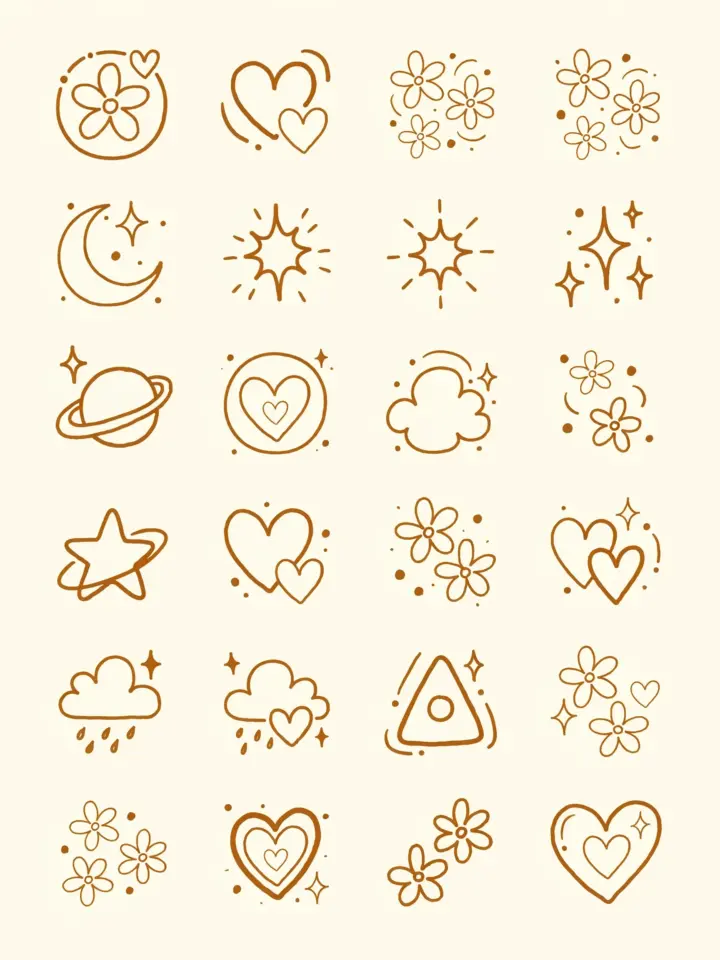
If you have been looking for drawing for beginners that actually feels fun and doable, you have come to the right place. I have tested dozens of little exercises over the years, and the ones that stick are always the playful ones. No pressure, no perfectionism, just a pencil and a sketchbook. These doodle ideas are designed to turn that blank page anxiety into a quiet, rewarding moment. And they really do work, even if you have not drawn since grade school.
Simple Shape Gardens: Grow Your Doodle Confidence
One of the easiest places to start is by creating a tiny garden made entirely of basic shapes. Circles become soft flowers, triangles turn into leaves, and wiggly lines become stems. You do not need to know how to draw a realistic rose. Instead, stack a few circles on top of each other, add a small curved line for the stem, and let the petals overlap.
This theme works because it removes the fear of getting proportions wrong. I like to fill a whole page with these shape-based plants, leaving some blank spaces for extra doodles later. You can even add a small sun using a few straight lines radiating from a circle. The more you practice, the more your hand will learn to move freely.
- Start with a circle for the flower head.
- Add smaller circles inside for petals or dots.
- Draw a thin, slightly curved line downward for the stem.
- Attach one or two small triangles for leaves.
- Repeat and vary the sizes for a relaxed, organic look.
Moody Monochrome Patterns for Mindful Sketching
When you want something that feels calming but still creative, try drawing repetitive patterns with just one pencil. Hatching, cross-hatching, stippling, and simple zigzags can create texture and depth without any complicated sketching. I often pick a single shape like a square or a teardrop and fill it with different patterns.
This is not about making a masterpiece. It is about giving your brain a gentle focus while your hand moves. You might fill one section with tiny dots, another with parallel lines, and a third with little spirals. The contrast between light and dark areas makes the final piece look detailed, even though each part is very simple. For beginners, this builds control and patience without frustration.
Everyday Object Doodles: Turn the Mundane into Art
Instead of trying to draw grand landscapes, look around your desk or kitchen. A coffee mug, a houseplant, a pair of glasses, or a spoon can be turned into a cute doodle with a few lines. The trick is to simplify. Forget the realistic shading and focus on the outline. A coffee mug is basically a rectangle with a curved handle. A lamp is a triangle on a stick.
I find that drawing objects I use every day makes the practice feel less intimidating. You already know what they look like, so your brain has less work to do. Try drawing five small objects on one page, leaving plenty of space around each. Give them little faces or tiny patterns for a whimsical twist. This is a great way to practice pencildrawing techniques without spending hours on one subject.
Line Adventures: Blind Contour and Continuous Line Doodles
If you want to loosen up your hand, try a blind contour drawing. Look at an object, but do not look at your paper. Let your pencil follow the edges you see. The result will be messy and wobbly, and that is exactly the point. It breaks the habit of making stiff, over-controlled lines. After a few tries, your lines will become more confident.
Another variation is the continuous line doodle. You keep your pencil on the paper without lifting it, moving slowly around a subject. You can create a whole face, a leaf, or a animal using just one long line. The gaps and overlaps give the drawing a charming, sketchy feel. I like to do this for five minutes before starting any other art activity. It warms up the hand and clears the mind.
Nature Sketchbook Prompts: Leaves, Shells, and Stones
Nature is full of forgiving shapes that look beautiful no matter how you draw them. A single leaf can be drawn in dozens of ways: with a central vein and tiny side veins, or with a smooth edge and a curved stem. A shell can be a spiral with a few radiating lines. A small stone can be an oval with a shadow underneath.
For a quick and rewarding session, collect a few natural objects from your garden or a walk. Place them in front of you and draw them one by one. Do not erase anything, just keep going. The slight imperfections make each sketch look organic and genuine. This is one of my favorite easysketching activities because it connects you to something real while building observational skills.
Animal Doodles in Under Two Minutes
Drawing animals can feel overwhelming, but you can break them down into simple parts. A cat is a circle for the head, two triangles for ears, an oval for the body, and a curved line for the tail. A bird is a small oval with a triangle beak and a fan tail. You do not need to capture every detail. The goal is to capture the essence in a few quick lines.
I recommend keeping a small list of animal ideas in your sketchbook. Bird, fish, cat, dog, rabbit, turtle. Spend just a minute or two on each. Over time you will develop a personal style. If you want to add a bit of texture, use short strokes for fur or scales. This practice is wonderful for improving hand speed and observation at the same time.
How to Keep Your Sketchbook Inspiration Alive
Starting a sketchbook is easy, but keeping it going takes a little strategy. I recommend leaving the first few pages blank, or filling them with the simplest possible doodles so you do not feel pressured. Date each page, even if you
#drawingforbeginners #doodleideas #pencildrawing #sketchbookinspo #easysketching
Leave a Comment