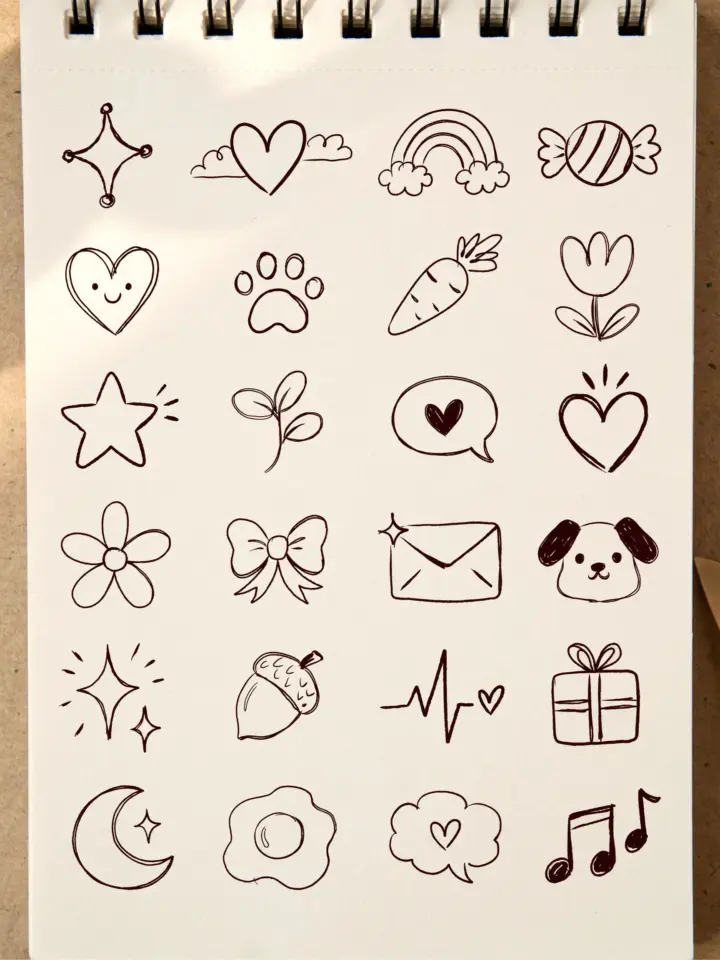
If you have ever wanted to try drawing but felt intimidated, easy doodle ideas for beginners are the perfect place to start. I have been filling sketchbooks for years, and the simplest patterns often become my favorite pages. This spring, I am especially drawn to repeating shapes and soft floral forms that feel almost meditative. You do not need any special training to create something that looks genuinely lovely. Just a pen, some paper, and a willingness to let your hand wander.
Simple Repeating Patterns to Build Muscle Memory
The fastest way to build confidence is to repeat one shape over and over. Try drawing a row of tiny circles, then another row with a dot inside each circle. Next, add a row of half circles or scalloped lines. These repetitive motions train your hand to move smoothly without overthinking.
I like to start each sketchbook session with five minutes of pattern practice. It warms up my wrist and clears my mind. You can mix curves and angles for contrast. A line of zigzags followed by a line of soft waves creates a rhythm that feels satisfying to complete.
- Dot grids – make rows of dots, then connect them with curved lines.
- Spiral stacks – draw small spirals in a vertical column.
- Checkerboard squares – fill alternating squares with crosshatching.
- Leaf chains – simple oval leaves connected by a thin stem.
These patterns work well as borders or fillers between larger doodles. Once your hand remembers the motions, you can combine several patterns into one cohesive page.
Floral Motifs for Spring Sketching
Because it is spring, I have been obsessively drawing little flowers that look like the ones blooming in my garden. Start with a single petal shape, then arrange five or six around a tiny center dot. That is basically a daisy. For a more abstract flower, draw a circle, then add a series of loops around it, like a pom pom.
You can also vary the size. Small clustered flowers work well in corners, while one large bloom can anchor an entire page. I keep a reference photo of a tulip on my phone, but I never try to copy it exactly. I simplify the shape into a few curved lines and a stem. The looseness is what gives hand drawn art its charm.
Try adding leaves with a single line down the middle. That small detail makes the doodle look finished without extra effort. For variety, alternate between round petals and pointy petals. Mixing styles keeps your sketchbook from feeling repetitive.
Abstract Lines and Doodle Landscapes
Abstract doodling is my go to when I want to relax but still make something interesting. Start with one continuous line that snakes across the page. Then go back and add dashes, dots, or tiny circles along the line. This creates a dynamic texture that feels almost like a landscape from above.
You can also build a simple horizon line. Draw a wavy line across the middle of the page. Above it, add small clouds made of overlapping circles. Below it, draw horizontal dashes to suggest grass or water. This technique works even if you have never drawn a landscape before. It is purely about suggestion, not realism.
Another idea is to fill a shape with abstract lines. Draw a large triangle or circle, then fill it with parallel lines that curve slightly. The contrast between the crisp outer shape and the soft interior lines looks modern and intentional.
Build Confidence with Daily Doodle Prompts
I used to stare at a blank page and feel stuck. Now I keep a running list of tiny subjects that I can draw in under two minutes. A coffee cup, a leaf, a star, a fish, a lamp. These small wins add up. I recommend setting a timer for ten minutes and doodling as many different things as you can.
One prompt I especially love for drawing for beginners is to pick a single letter of the alphabet and turn it into a picture. Turn the letter C into a crescent moon or a curved snake. Turn the letter L into a corner of a building. This playful approach takes the pressure off having to invent something from scratch.
Another method is to combine two unrelated subjects. Draw a fish with a flower tail or a cloud shaped like a cat. These silly combinations often produce the most memorable sketches. And they remind you that doodling is supposed to be fun, not perfect.
How to Fill a Sketchbook Page Without Pressure
A common fear is ruining a nice sketchbook with a bad drawing. I got over that by embracing the half filled page. Leave white space intentionally. You can always come back later and add a pattern or a splash of color. Some of my favorite spreads have only three or four doodles with lots of breathing room.
One practical trick is to divide the page into six rectangles using light pencil lines. Then challenge yourself to fill each rectangle with a different simple pattern. This gives structure without demanding a masterpiece in each section. It is especially helpful when you are looking for sketchbook inspiration that does not require
#doodleideas #easydoodles #sketchbookinspiration #drawingforbeginners #handdrawn
Leave a Comment