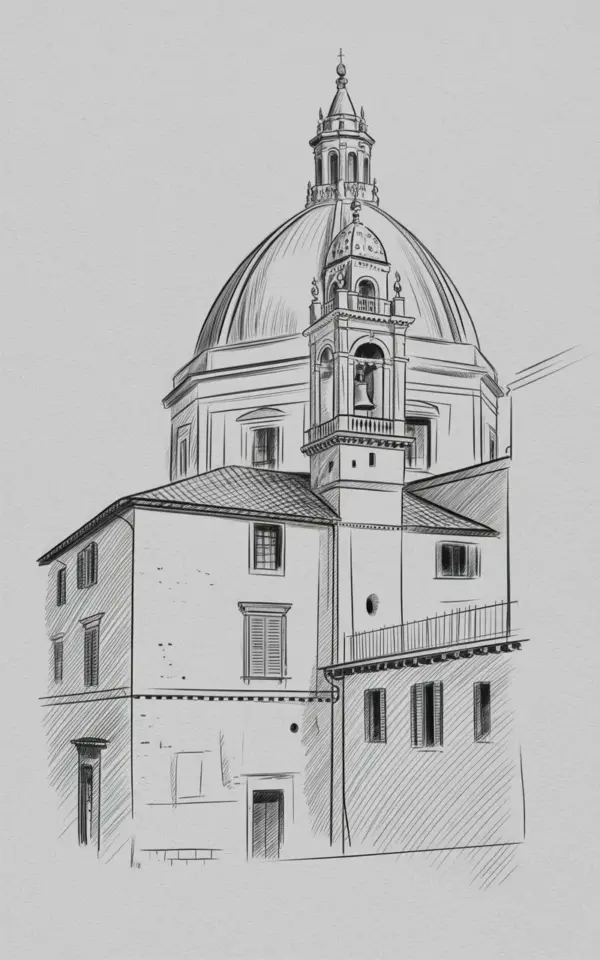
I still remember the first time I attempted an Italian church pencil sketch. I sat on a low stone wall near a piazza, sweating under the afternoon sun, and I thought, “How do people even start something like this?” The building in front of me was all curves and corners, a dome that seemed to float and a bell tower that sliced into the sky. But here’s the thing: you don’t need natural talent or years of practice. You just need a pencil, a little patience, and the willingness to draw something imperfect. And honestly, that early sketch of mine looked more like a lopsided mushroom than a church. But I kept at it. This Italian church pencil sketch of a historic building with a prominent dome and bell tower is exactly the kind of subject that teaches you the most. So if you’re new to sketching architecture, or you just want a fresh reference for your spring trip plans, let’s walk through it together.
Why This Pencil Sketch of an Italian Church Dome and Bell Tower Works for Beginners
Look, when you open a travel art book or scroll through Pinterest, you see these polished, perfect drawings. It’s intimidating. But this particular sketch of a white-washed Italian church with a large rounded dome and a bell tower is actually a dream for anyone starting out. Why? Because the building has clear, separate parts. The dome is one big shape. The bell tower is another. The rectangular windows with detailed shutters sit neatly in rows. You can tackle each piece one at a time, no overwhelming complexity.
I love that the sketch shows careful attention to shading and perspective, but it’s not hyper-realistic. There’s a looseness to it. You can see the artist made choices about where to press harder and where to let the paper breathe. That’s what you should aim for too. Not perfection. Just a honest attempt to catch the light and shadow on those ornate shutters and the decorative spire at the top. It’s a great model to copy, to trace, to analyze. So if you’re thinking “I can’t draw a straight line,” ok so use a ruler. Nobody’s judging.
Breaking Down the Dome and Bell Tower Drawing Step by Step
Start with the biggest shapes. That dome is a rounded half-oval sitting on a drum with small rectangular windows. Draw a light oval first. Then sketch a boxy base beneath it. The bell tower rises on one side (or sometimes both sides, but here it’s prominent on the left side of the composition). Don’t worry about the decorative spire yet. Just get the main blocks right.
Next, add the bell tower’s balcony level. This sketch shows a small balcony with a railing. It’s a straight horizontal line with tiny vertical posts. Honestly, those posts are super forgiving. You can draw them unevenly and it still looks charming. Then move to the dome’s top. You see a spire with ornate finials – those little knobs and crosses at the very peak. I always mess those up. I draw them too big or too small. But you know what? It’s fine. The overall silhouette carries the feeling of Italy.
- Lightly block the main forms: dome, bell tower, main rectangular body.
- Add the balcony and railing details on the tower.
- Draw the windows in evenly spaced rows – the shutters are just small angled rectangles.
- Sketch the spire and finials as simple shapes first, then refine.
- Shade the shadow side of the dome and under the eaves. That’s where the depth lives.
I like to use a 2B pencil for the initial lines and a 4B or 6B for dark shadows. That’s it. Nothing fancy. The sketch in the image uses a range of tones – you can see the dark shutters against the light wall. That contrast makes the building pop.
Why I Love Sketching Architectural Details Like Shutters and Spires
Not gonna lie, the fun part for me is the tiny stuff. The ornate shutters on those small rectangular windows. The decorative elements on the spire. They’re like little puzzles. You’re not just drawing a window; you’re drawing the way the light falls on two angled slats. And the spire with its finials? Each knob, each cross, each little curl – it’s a chance to practice line weight. Press lightly for the far away parts, press harder for the ones in front.
Here’s an odd thing I do: I sometimes sketch the shutters first with my non-dominant hand. Just to get them loose. It sounds ridiculous, and my first attempts look like squashed bugs. But it trains your eye to see the shape instead of the label. You stop thinking “that’s a shutter” and start seeing “that’s a dark rectangle with a diagonal line.” That shift is everything. And when you finally nail a spire finial that actually looks like it could hold a weather vane? Honestly, it’s a tiny triumph. I once spent an hour drawing the same little cross on a bell tower, erasing and redrawing, and the neighbor’s cat watched me the whole time like I was crazy. Totally worth it.
Using This Sketch for Travel Journal Inspiration
Travel art isn’t about producing a gallery-worthy piece. It’s about remembering the afternoon you sat in a café across from a white church with a dome that gleamed in the spring light. This pencil sketch is perfect for a travel journal because it’s monochrome – you can add a few watercolor washes later if you want, or leave it black and white. The detailed shading gives you a map of light and shadow to follow.
If you’re planning a trip to Italy this spring, I’d say start practicing now. Find a photo of a similar church (or use this sketch as your reference) and draw it three times. First time, just the outline. Second time, add windows and shutters. Third time, go wild with shading. You’ll be amazed how much faster and more confident you get. And when you’re actually standing in front of that duomo, you’ll have the muscle memory to pull a decent sketch in ten minutes. Then you can move on to eating gelato. Priorities.
Tips for Shading and Perspective in an Architecture Sketch
Perspective sounds scary but for a single building like this, you really only need one-point perspective. The building is mostly facing you. The dome is a circle in perspective – an ellipse. The bell tower is a box. The slate roofs on the side? Those are tilted rectangles. Draw a faint horizon line and mark a vanishing point, but honestly? For a quick sketch, you can eyeball it. Here’s the secret: keep your vertical lines straight up and down (use the edge of your page as a guide) and let the horizontal lines slant slightly downward if they’re above your eye level.
Shading is where the magic happens. Look at the sketch: the left side of the dome is darker, the right side lighter. That tells you the light source is coming from the right. So shade the left side of the bell tower too. Use hatching – parallel lines close together for dark areas, further apart for lighter areas. Cross-hatching (adding a second layer of lines at an angle) gives you even deeper darks. I always start shading too lightly and have to go over it again. That’s normal. Build up gradually.
What to Pack for a Spring Trip Sketching Session
You’re heading out to sketch a beautiful Italian church – spring in Italy is mild but unpredictable. Bring a small sketchbook, no bigger than A5. It fits in a jacket pocket. A mechanical pencil (0.5mm lead) is great because you never need a sharpener. Add a softer pencil like a 6B for shadows, a kneaded eraser (they lift graphite without smudging), and a tiny pencil case. That’s it. Honestly, you could even skip the eraser and just draw with intention.
I also bring a portable stool or a folded jacket to sit on. My back hates hunching over. And a thermos of espresso? Ok so maybe that’s just me, but there’s something about sipping strong coffee while you shade a bell tower that feels right. Also bring a reference photo on your phone – the sun moves, shadows shift, and you’ll want to lock in that particular moment of light. But don’t rely on the photo too much. Let your eye wander. Sketch the actual building, not the image.
How This Sketch Can Boost Your Art Reference Library
If you’re building a collection of travel art references, this Italian church pencil sketch is a real workhorse. That dome shape appears on countless cathedrals. The bell tower design is similar to campaniles you’ll see in Rome, Florence, and smaller hill towns. The decorative spire with finials? That’s a classic baroque touch you’ll find all over the Mediterranean. By studying this one drawing, you learn a visual vocabulary you can reuse again and again.
Try this: copy the sketch twice. On the second copy, change the windows to arched ones instead of rectangular. Or add a second bell tower on the right. Suddenly you have a different church. That’s the power of isolating architectural elements. You start seeing buildings not as monolithic blocks but as collections of domes, towers, shutters, and spires. And once you’ve drawn that spire finial a few times, you’ll notice it on every Italian church you visit. It becomes a little game. “Oh, that’s the same kind of knob as the one I drew.” Art is just recognition with a pencil.
So save this pin, print the sketch out, and put it in your workspace. Trace it, copy it, color it, mess it up. The only way to get better is to make a lot of drawings, some of which will be awful. I have a whole sketchbook of awful bell towers. But every awful one taught me something about where the shadow should fall on that large rounded dome. You’ll get there.
Now grab your pencil. Find that old sketchbook. Draw a dome, draw a bell tower, be patient with yourself. And when you’re done, share your progress. I’d love to see what you create.
#italianchurch #pencilsketch #travelart #architecturesketch #springtravel
Leave a Comment