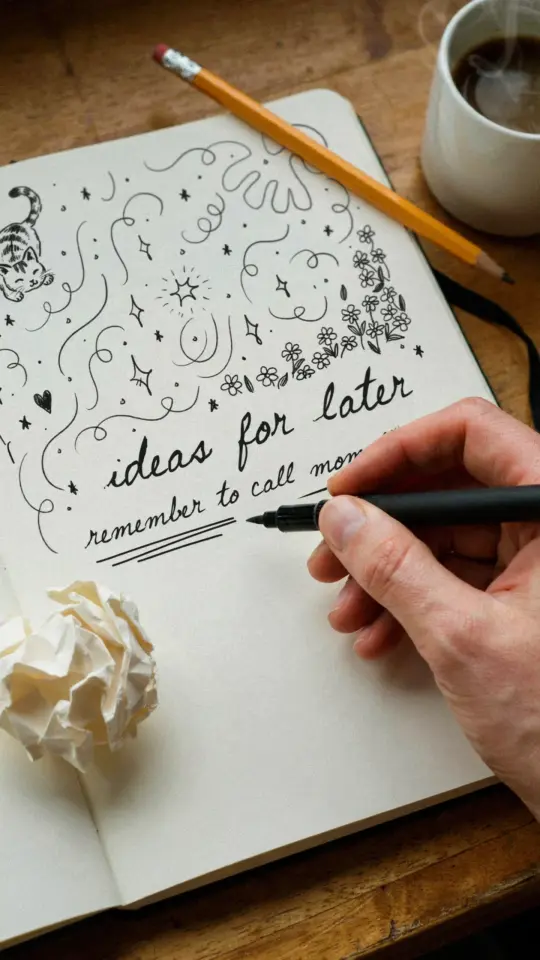
You are hunched over your sketchbook. The page is blank, your pencil is in hand, and you want to draw something that feels like a break from your brain, not another chore. Honestly, the best way to do that is a symmetrical pattern tutorial, but not the kind that feels like math homework. I mean the kind where you just draw a line down the middle and start mirroring messy shapes. The kind of mirror doodle idea that has saved me from a hundred boring bus rides and restless evenings.
If you have tried this before, you probably hit a wall. You drew one half of a flower or a squiggle, tried to copy it on the other side, and it looked lopsided. So you ripped the page out. I get it. That frustration is the exact reason I wrote this guide to the relaxing art sketchbook process, because making the mistakes is normal, but knowing how to fix them permanently changes the game.
Why symmetrical doodling feels hard at first (but is actually foolproof)
Here is the dirty secret about symmetry: it is all about how you move your hand, not how you see. When you try to copy a line from the left side to the right side, your brain starts overthinking. It wants the copy to be exact, so you slow down, press harder, and mess up the fluid stroke that made the first side look good.
The mistake is trying to draw a whole complex shape at once. You draw a leaf on the left with three curves. Then you try to draw that leaf on the right and choke on the details. You have to chunk it down. Draw one curve of the leaf on both sides. Adjust. Then draw the next curve. That is it. That is the whole secret to a mirror doodle idea that works.
Another huge mistake is starting too close to the edge of the paper. If you draw your center line dead center but start your pattern near the bottom corner, you run out of room and panic. That panic creates those cramped, stilted lines at the end. It looks rushed because it was rushed.
Common mistake number one: drawing a shaky or uneven center line
This one sounds so stupid that nobody talks about it. But if your middle line is crooked, your entire symmetrical pattern tutorial is built on a lie. You start measuring distance from the line, but the line bends, and suddenly your pattern looks like it melted.
Fold your paper in half instead of drawing the line. If you are working in a sketchbook that won’t fold easily, which happens to me all the time with thick mixed media paper, place a ruler down and draw a hairline pencil mark. No, a hard graphite line will not help you. It leaves a shadow you have to erase later and it breaks your concentration. A soft, faint line is better because it guides you without demanding attention.
For those of you using darker paper or a sketchbook with a heavy spine, an alternative is to count dots. Put two dots at the top and two at the bottom. Align them visually as you draw. It sounds tedious but it takes four seconds and saves you from the wobbles.
Starting with symmetrical flowers or geometric shapes is a trap
Do not start with a rose. Do not start with a mandala. You will fail, not because you are untalented, but because those subjects involve many overlapping layers and they require spatial reasoning that you are not warmed up for.
Begin with something dumb, like a potato. A blob. A bean. Draw a freehand oval on the left side of the line. Then draw a rough mirror oval on the right. They will not match perfectly. That is okay. But after two tries, your hand starts to understand the rhythm of “mirroring” better.
Once blobs feel okay, move to simple leaves. Then to basic teardrops. Then to repeating waves. You are building a physical memory of how to move your eye from one side to the other. Using a symmetrical pattern tutorial that involves starting super basic is not boring, it is strategic.
Here is a list of things you can doodle that are forgiving for beginners:
– Petals that are purely curved lines.
– Crescent shapes facing one another.
– A spiral that goes in different directions.
– Small dots and circles scattered near the center line.
– Overlapping seashell-like spirals.
– Honestly, just clouds.
The myth of perfect symmetry: why wobbles make it beautiful
Look, I need to tell you something that took me ages to learn. Perfectly symmetrical patterns are boring. They look like clip art. They look like a computer generated them, and nobody wants a computer in their sketchbook.
The human hand cannot draw perfect symmetry, and that is exactly why these drawings look good. The tiny differences, the millimeter off on the right side, the slightly fatter curve on the bottom, that is what gives the work life. It shows the viewer that a person made it.
Here is the thing to remember: if you obsess over matching every single line, you will tighten up. The relaxed, loose drawings come from a hand that is moving fast and only glancing at the other side. Stop staring. Glance, adjust, move on.
I have a sketchbook page where the left side looks like a neat fern and the right side looks slightly sleepy and droopy. I did not erase it. I kept it. Now it is my favorite page because it has personality. The mistake became the charm.
Overthinking the mirror reflection ruins your creative flow
When I tried this the first time, I kept looking at the mirror image in my head. I wanted to flip the shape exactly, like a reflection in a lake. But the problem is that your brain is not good at visualizing a literal flip when you are stressed.
Instead of thinking about a mirror, think about it as “echoing” the shape. If you make a curve that goes out and up, make your next curve go out and up. Do not think about left and right. Think about actions. Up becomes down. Out becomes in. You are not flipping the line, you are just matching a gesture.
This mental shift is the thing that made me not hate my sketches. I stopped acting like a cop measuring the drawing. I started acting like a musician playing the same melody slightly lower. Keep the movement going. Make it a rhyme, not a photocopy. That is how you avoid a stiff, dry page.
How to turn symmetrical doodles into a relaxing art sketchbook ritual
It is very easy to turn this into a chore. You sit down, scream “I will be mindful”, and then immediately grind your teeth because the pattern is coming out wrong. That is not relaxing.
To make this feel like actual downtime, you need to change your environment. This might sound fluffy, but I promise it is practical. Put on a podcast that you have listened to before. Half-listening is the sweet spot, because your brain is busy but your hands are free. You want the drawing to happen almost without your permission.
Here are a few other low-effort ways to keep it fun:
– Use a pen with no eraser. Lose the safety net, it is freeing.
– Limit yourself to one shape. Just repeat it for twenty minutes.
– Color in only the gaps between the shapes with a marker.
– Use a colored pencil for the right side and a normal one for the left.
– Do not show it to anyone. Perfectionism dies when nobody is watching.
Also, use a good, smooth pen. If your pen skips on the paper, you will get annoyed. Nothing kills a relaxing art sketchbook session faster than a ballpoint that separates into a weird, grooved fade in the middle of a curve. Use a gel pen or a fineliner. Yes, it matters.
What actually works when you want a pretty result without editing
Since this whole post is about mistakes, I should tell you what I do that works every single time. It is a simple sequence. It takes about ten minutes.
First, I draw the faint center line. Then I pick a shape that is basically two strokes, like a teardrop. I draw one teardrop on the left, near the top third of the page. I draw the matching one on the right. Then I double the size. Then I add a small extension to the bottom of each.
Once the page fills up, I go back and add detail inside the existing shapes. Crosshatching, dots, little circles. But here is the trick: I only add detail when my hand starts moving slower. That slowness is your signal to stop. When you are trying to force the pattern, it looks bad. When you let the pattern take its time, it works.
And the truth is, you do not need a perfect plan. You need a starting point and a hand that is willing to make a noise on the page. Do not let the dread of an empty page win.
Symmetrical drawing is a quiet, ancient kind of fun. It is like building a sandcastle on paper; you are rearranging the same bits of line and curve into something that feels balanced. If this tutorial helps you get one good doodle, or even just a few minutes of silence, it did its job.
The best time to start this was an hour ago. The second best time is right now, with a pen you actually like and no judgment. So go draw a crooked line down a blank page and see what happens. I am betting you will like it.
Leave a Comment