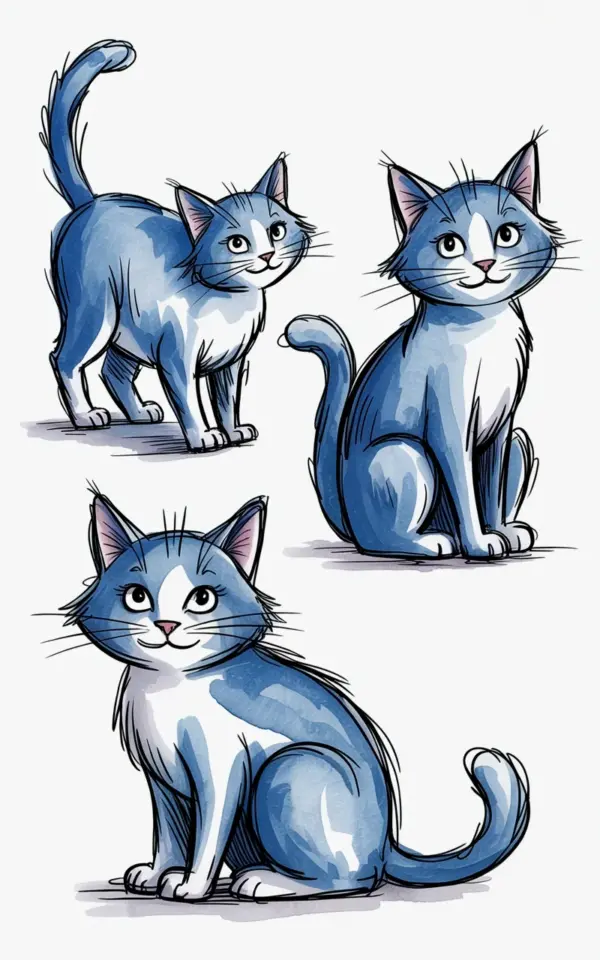
Finding Budget Friendly Watercolor Supplies for Cat Sketching
You do not need expensive artist grade paints to capture the charm of these three blue cats. A basic watercolor set from a drugstore or online retailer costs under $10 and gives you plenty of pigment for loose washes. I personally use a small palette of five or six blues, like cerulean, ultramarine, and cobalt, plus a tube of white gouache for highlights. For paper, grab a pad of cold press watercolor paper from a discount art store or even a mixed media sketchbook. It holds up to multiple washes without buckling too much. A round brush in size 6 or 8 and a flat brush for larger areas are all you really need. Adding a cheap spray bottle helps you control wetness for those soft, blurred edges.
Breaking Down the Three Blue Cat Poses for Animation Art
The top cat in the reference image stands with its tail raised high. That playful stance is perfect for studying a character’s line of action. In animation, a strong curve from nose to tail tip creates energy. The middle cat sits upright with a relaxed expression. Notice how its ears are slightly forward and its eyes are half closed. That’s a great resting pose for a calm scene. The bottom cat sits in a more formal position with its tail curled around its body. This pose feels grounded and patient. When you practice these three positions together, you cover a range of moods that are useful for storyboard sketches or fan art sequences. Try sketching each pose first with a light pencil line to lock in the gesture before adding water.
How to Capture Playful Gestures with Soft Blue Washes
Start by wetting the area of the cat’s body with clean water. Then drop in a pale blue wash, letting it spread naturally. For the standing cat, keep the wash lighter around the belly and darker at the back. The white highlights left from the paper give the fur texture without extra work. For the sitting cats, use a slightly thicker mix on the shadows under the chin and along the tail. Let each layer dry completely before adding a second pass. That prevents muddiness. If you want the formal sitting cat’s tail to look curled, paint a thin stripe of darker blue along the outside curve. Use a tiny brush for the eyes and nose. Remember, the reference image uses white highlights on the chest and forehead. You can achieve that by lifting wet paint with a dry brush or by adding a dab of white gouache later. Both methods cost nothing extra.
Using These Cat Sketches as Drawing Ideas for Your Sketchbook
These three poses are easy to modify into your own characters. Change the tail angle on the top cat to make it look curious instead of playful. Add a simple background like a blue cushion or a window frame to turn the middle cat into a cozy illustration. The bottom cat’s formal posture works well for a regal cat character in a fantasy animation. You can also combine the poses into a single scene: one cat prowling, one lounging, one sitting proudly. That gives you a ready made composition for a fan art piece or a children’s book idea. Save the reference image on your phone or pin it to a board for later. When you feel stuck, come back and redraw one of the cats with a different color palette, like warm oranges or purples, to see how the mood changes.
- Use the standing pose to practice action lines and weight distribution.
- Use the relaxed sitting pose for studying facial expressions in watercolor.
- Use the formal sitting pose to work on tail curls and negative space around the body.
- Combine all three into a single page to create a mini storyboard.
Affordable Ways to Practice Cat Sketching Daily
You do not need a model or a fancy studio. Search for free cat photo references online or take quick shots of your own cat on your phone. Print them in black and white to focus on value rather than color. Then sketch them in blue watercolor on cheap newsprint or printer paper just to practice gesture. Another low cost trick is to use a small travel watercolor set and a pocket sketchbook. Carry them with you and do a five minute cat sketch whenever you wait for coffee or ride public transport. Over a week, you will have dozens of small studies. Each one sharpens your ability to capture a cat’s unique pose quickly. That skill translates directly into animation art, where you need to draw characters in motion without overthinking.
Why Blue Cat Art Works for Animation Inspired Practice
Blue is a forgiving color for beginners. It mixes easily, creates clean shadows, and does not stain paper as badly as red or yellow. A monochrome palette forces you to focus on shape and contrast instead of complex color theory, which is exactly what animation storyboards often require. The white highlights in the reference image add dimension without extra effort. Plus, blue cats
#WatercolorCats #CatSketching #AnimationArt #DrawingIdeas #BlueCatArt
Leave a Comment