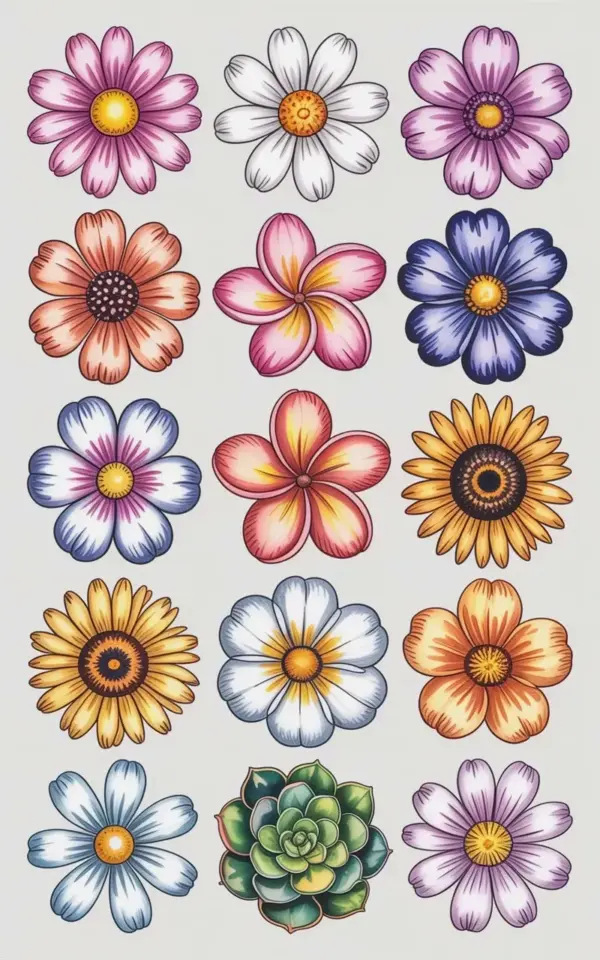
There’s a specific kind of quiet that settles in when you sit down with a watercolor tray and a jar of cloudy brush water. You almost expect the reference sheet to do the painting for you, but this collection of 15 hand-drawn watercolor flowers won’t. What it will do is give you a solid starting point, as long as you avoid a few classic mistakes. Honestly, I’ve made every single one of these, and I’m still learning.
Mistake #1: Treating the Grid as a Coloring Book
Look, that light gray grid with the pink daisy and the white daisy side by side? It’s not a paint-by-numbers setup. I’ve seen people try to replicate row by row, matching every petal exactly, and they end up with stiff, lifeless blooms. The whole point is to use these flowers as a visual dictionary. You peek at the coral cosmos to understand how petals curve around a brown center, then you apply that idea to your own shape.
So instead of copying, treat each square like a handshake. Get familiar with the structure, then break away. Your art journal should not look like a photocopy. It should look like you were thinking while you painted.
Mistake #2: Overworking Every Petal
Here’s the thing about watercolor: it dries faster than you expect, and then you panic. You add another layer, and another, and pretty soon that pink plumeria with orange undertones looks muddy. The overworking mistake is real, and it’s the number one reason people quit painting practice. They think the reference is suggesting more detail, when it’s actually showing how light and translucent the wash should be.
Next time you feel the urge to fix a petal, stop. Let it dry. Come back later. One confident stroke is worth ten nervous ones. I once spent an entire train ride trying to paint a sunflower from memory. It looked like a grumpy fried egg. The lesson wasn’t about sunflower anatomy, it was about knowing when to put the brush down.
Mistake #3: Ignoring the Centers of Your Blooms
Maybe a sunflower catches your eye, and you dive straight for the big yellow petals. But look at that dark brown center. That center is what makes a sunflower read as a sunflower. Same with the purple flower with a brown center, if you skip that detail, your flower just becomes a generic blob.
I get it, centers are small and fiddly. But they anchor everything. Take a moment to study how the center sits in relation to the petals. A tiny dot of color can completely change the character of a bloom. The mustard-yellow center on that navy blue flower, for example, is basically the whole personality of the piece.
Using This Collection for Art Journal Practice
Ok so, how do you actually use the grid for art journal practice without falling into the mistakes above? You start small. Pick one flower, maybe the light blue flower with white highlights, and paint it three times. First attempt, just gesture. Second attempt, focus on color mixing. Third attempt, pay attention to the white highlights. That’s enough for one session. This kind of painting practice doesn’t need to be dramatic or long.
- Trace the outline with a fine liner, then paint loosely. That helps you learn the shape without worrying about perfection.
- Blind contour on the first pass. Don’t look at your paper while you paint. It sounds ridiculous but it loosens you up.
- Use the grid as a color palette. Mix the exact colors you see, then paint them into a swatch chart.
- Give yourself permission to skip the flowers that don’t speak to you. Not every bloom is your teacher.
And if you only have fifteen minutes, that’s fine. One small flower is a victory. You don’t have to finish the whole grid to call it practice.
From Practice Sheets to DIY Crafts: What Actually Works
Once you have a few petals you’re proud of, don’t let them sit in a drawer. Cut out individual blooms and turn them into DIY crafts. Cards, bookmarks, gift tags, journal covers. I once turned a navy blue flower with a yellow center into the front of a birthday card, and the person thought I bought it at a stationery shop. That moment is not as rare as you’d think.
Your practice sheets are not throwaways. They’re raw
Leave a Comment